
We are the team that launches the impossible into orbit. For decades, ULA, and our heritage vehicles, have redefined what’s possible beyond Earth, launching with unmatched precision and purpose. We don’t just send rockets into space—we launch humanity’s boldest ambitions. At the edge of innovation, we deliver the missions that shape our world and unlock the future.
Demonstrating our deep culture of mission assurance, ULA rockets deliver critical payloads to the most complex and exotic orbits. Our engineering expertise enables us to tackle challenges others can’t—from intricate deep-space trajectories to the deployment of critical national security assets.
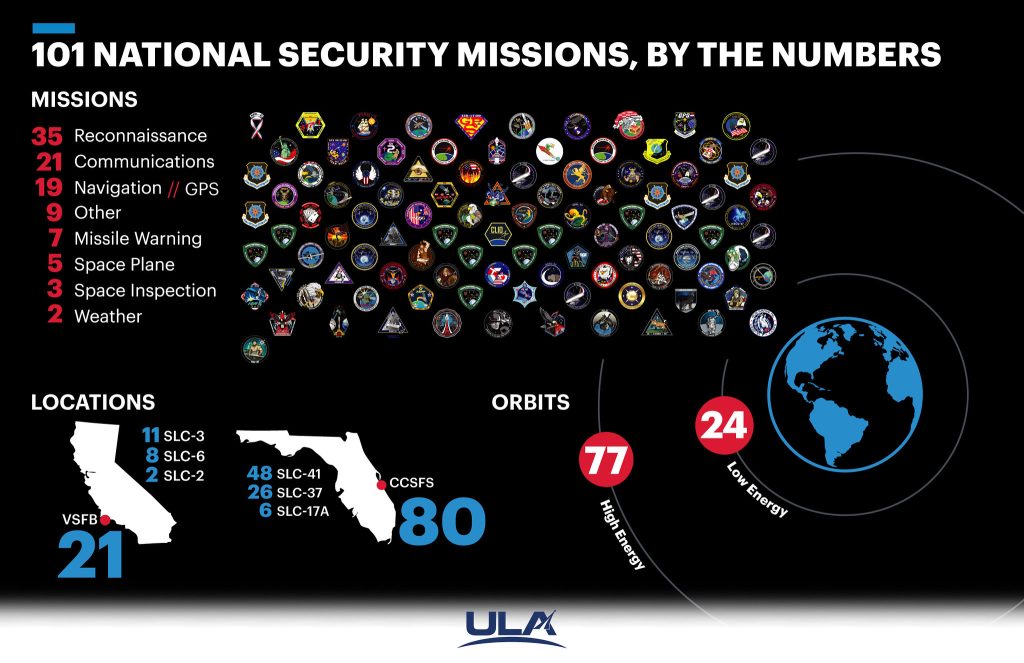
100+ national security missions successfully launched, safeguarding our nation’s interests with unwavering commitment and purpose.
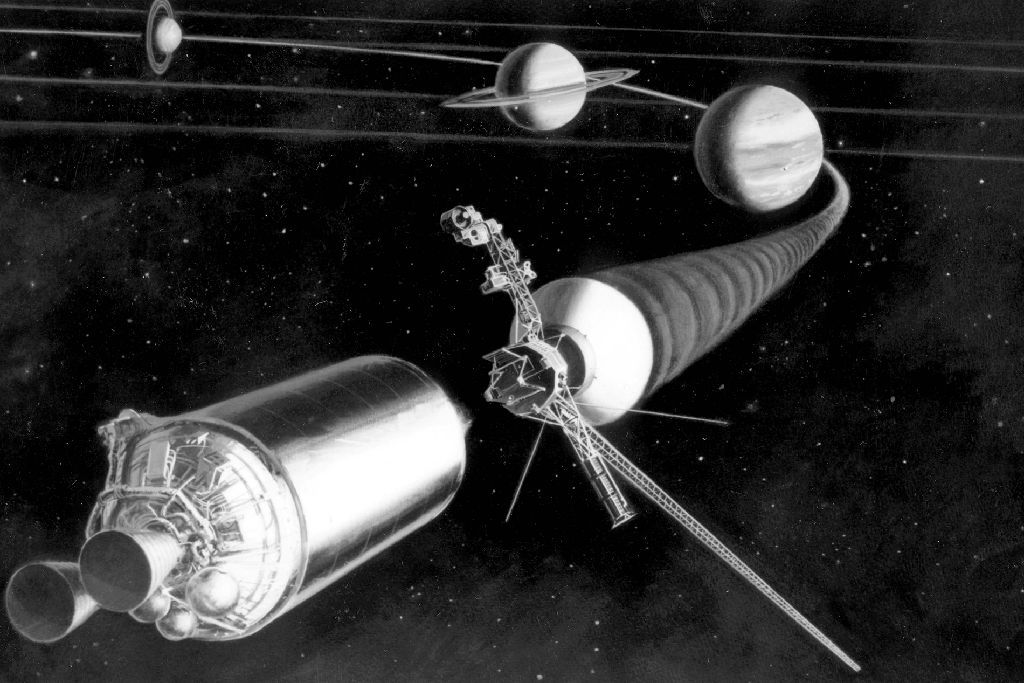
Pioneering deep space exploration: We’ve launched missions to every planet in our solar system, pushing the boundaries of scientific discovery.
Interesting intergalactic fact—we’ve launched all 20 U.S. missions to Mars.
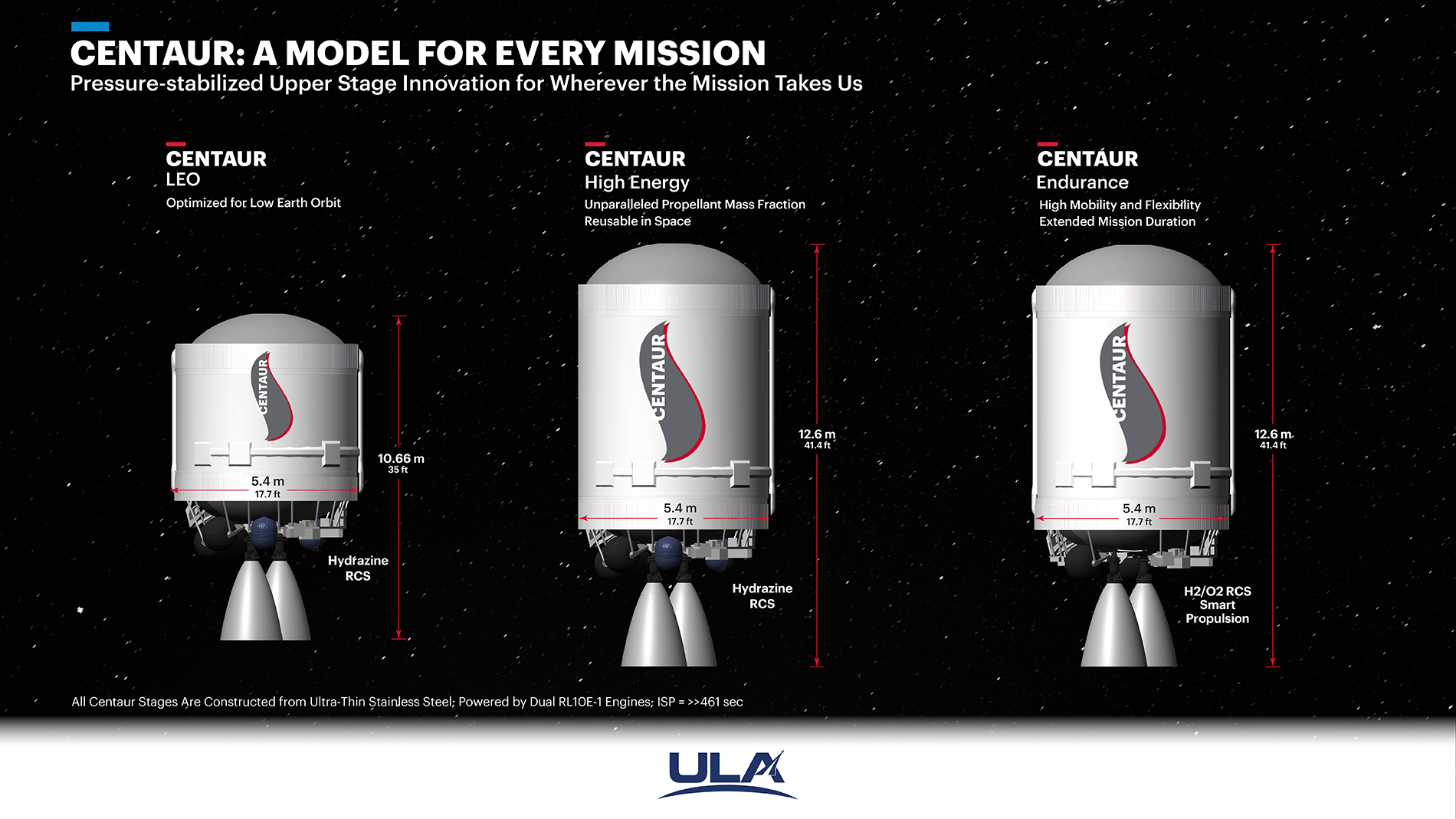
ULA’s Vulcan next-generation rocket offers a unique combination of modularity, power and precision unmatched by competitors. Its advanced Centaur V upper stage truly sets it apart. Providing unparalleled endurance and restart capability to deliver payloads to complex, high-energy orbits with pinpoint accuracy, Centaur is the performance advantage over other launch systems.
Vulcan’s booster is powered by innovative BE-4 engines and has a flexible design that can be configured with up to six solid rocket boosters, making it a single rocket that can efficiently handle the spectrum of missions from medium to heavy lift, a capability no one else offers in a single rocket.
Vulcan redefines what’s possible, offering unparalleled flexibility with the precision to go anywhere the mission requires.
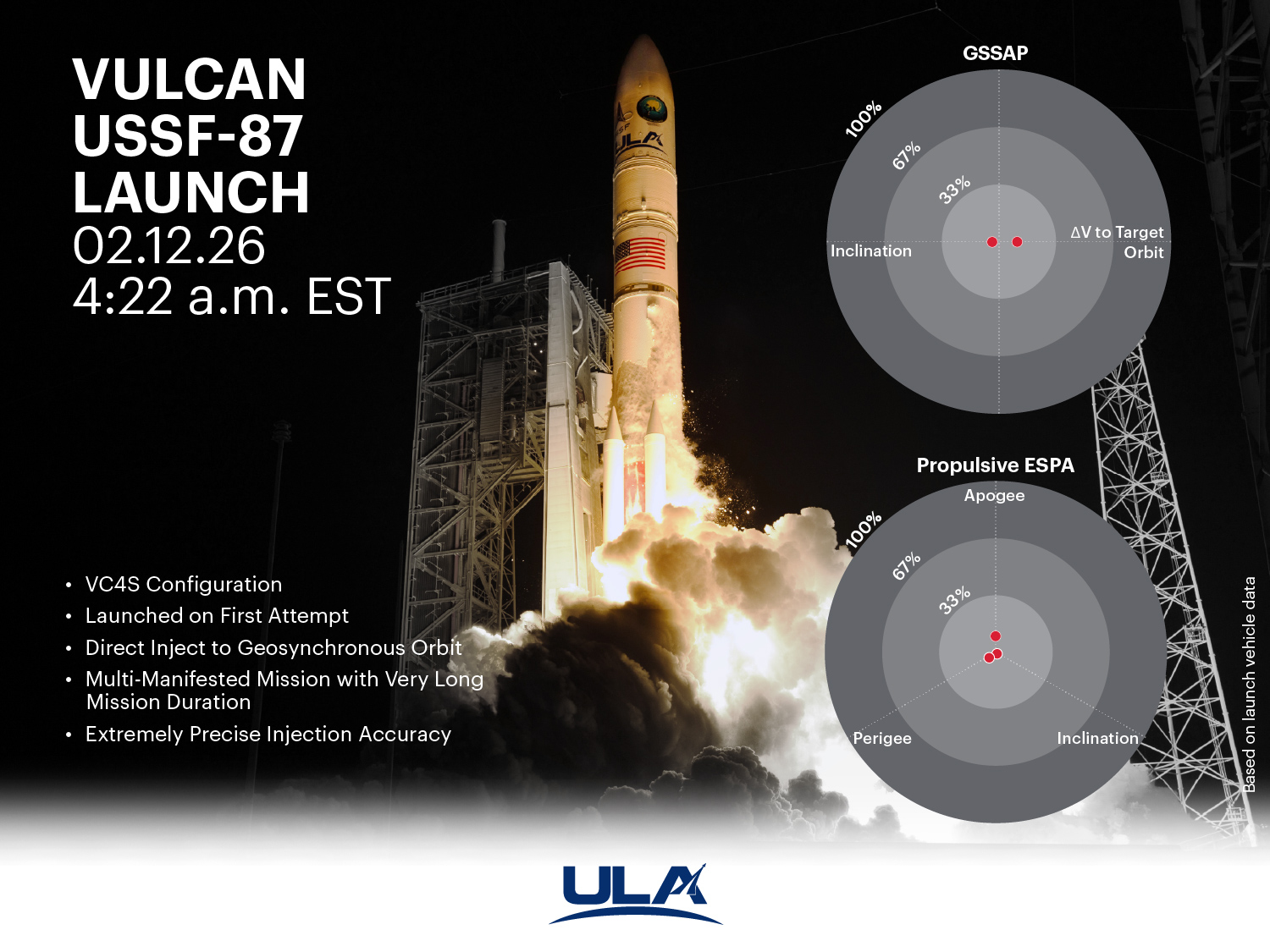
Delivering with absolute precision: Because when the stakes are highest, there’s no room for error.
ULA’s Vulcan next-generation rocket offers a unique combination of modularity, power and precision unmatched by competitors. Its advanced Centaur V upper stage truly sets it apart. Providing unparalleled endurance and restart capability to deliver payloads to complex, high-energy orbits with pinpoint accuracy, Centaur is the performance advantage over other launch systems.
Vulcan’s booster is powered by innovative BE-4 engines and has a flexible design that can be configured with up to six solid rocket boosters, making it a single rocket that can efficiently handle the spectrum of missions from medium to heavy lift, a capability no one else offers in a single rocket.
Vulcan redefines what’s possible, offering unparalleled flexibility with the precision to go anywhere the mission requires.
Delivering with absolute precision: Because when the stakes are highest, there’s no room for error.
At ULA, we believe in the boundless potential of space for humanity. For nearly two decades, we have been going beyond, relentlessly advancing expectations of what’s truly possible in the cosmos. Every launch is a testament to our unwavering commitment to precision, adaptability, and the audacious spirit of exploration that drives us to deliver the critical missions that shape our world and push the boundaries of human endeavor.
ULA’s rockets boast a tremendous success record, demonstrating our deep culture of mission assurance, consistently delivering critical payloads with unparalleled accuracy.
For decades, ULA has been the steadfast rocket launcher for vital U.S. national security. We've launched more than 100 national security missions, safeguarding national interests, and pioneered deep space exploration by sending missions to every planet in our solar system. Our efforts were foundational in deploying the Global Positioning System, essential infrastructure for billions worldwide.
Our Vulcan rocket is engineered for the most demanding missions, offering significant payload capacity: up to 60,000 pounds to LEO, 32,000 pounds to GTO, and 14,300 pounds direct to GEO.
ULA has secured landmark contracts affirming our future leadership in space. We're launching 47 missions for Amazon's Project Kuiper, the largest commercial agreement ever awarded in the industry. ULA was awarded a substantial $4.5 billion in the U.S. Space Force National Security Space Launch (NSSL) Phase 2 competition and $5.4 billion for the Phase 3 competition, ensuring our continued strategic role in national security for years to come.
In fact, we have more than 70 Vulcan missions already on contract and look forward to launching those missions for our commercial, civil and government customers.
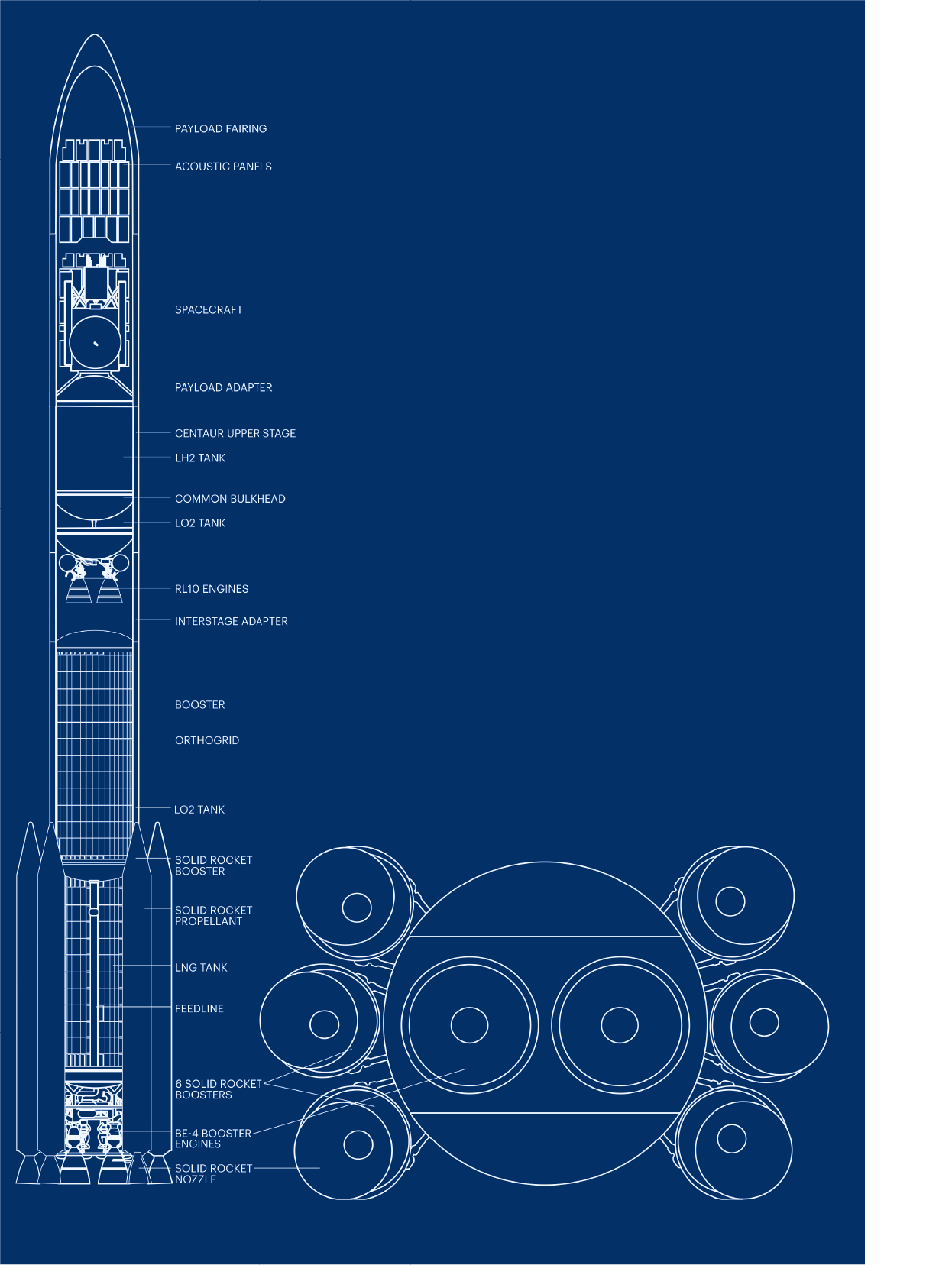
The spacecraft are encapsulated in a 17.7-ft (5.4-m) diameter standard payload fairing. The PLF is a sandwich composite structure made with a vented aluminum-honeycomb core and graphite-epoxy face sheets. The payload attach fitting (PAF) is a similar sandwich composite structure creating the mating interface from spacecraft to second stage and payload fairing (PLF). The PLF separates using a debris-free horizontal and vertical separation system with spring packs and frangible joint assembly. The payload fairing is available in the 51 ft (15.5 m) standard and 70 ft (21.3 m) long configurations.
The Centaur V second stage is 17.7 ft (5.4 m) in diameter and 38.5 ft (11.7 m) in length. Its propellant tanks are pressure-stabilized and constructed of corrosion-resistant stainless steel. Centaur is a cryogenic vehicle, fueled with liquid hydrogen and liquid oxygen, powered by two RL10C-1-1A engines producing 23,825 lbs (106 kilo-Newtons) of thrust. The cryogenic tanks are insulated with a combination of multilayer insulation (MLI) blankets, radiation shields and spray-on foam insulation (SOFI). A fault-tolerant avionics system is mounted on an aft equipment shelf. The payload attach fitting (PAF) provides structural and electrical interfaces with the spacecraft and is mounted to the Centaur V Launch Vehicle Forward Adapter (LVFA).
The booster is 17.7 ft (5.4 m) in diameter and 109.2 ft (33.3 m) in length. The booster’s tanks are structurally rigid and constructed of orthogrid aluminum barrels, spun-formed aluminum domes with a common bulkhead. The liquefied natural gas (LNG) / methane fueled booster will be powered by a pari of BE-4 engines, each producing 550,000 pounds (2,400 kN) of sea level thrust. Four solid rocket boosters (SRBs) generate the additional power required at liftoff, with each providing 459,600 lbs (2,044 kN) of thrust. The Centaur avionics system, provides guidance, flight control and vehicle sequencing functions during the booster and Centaur phases of flight.
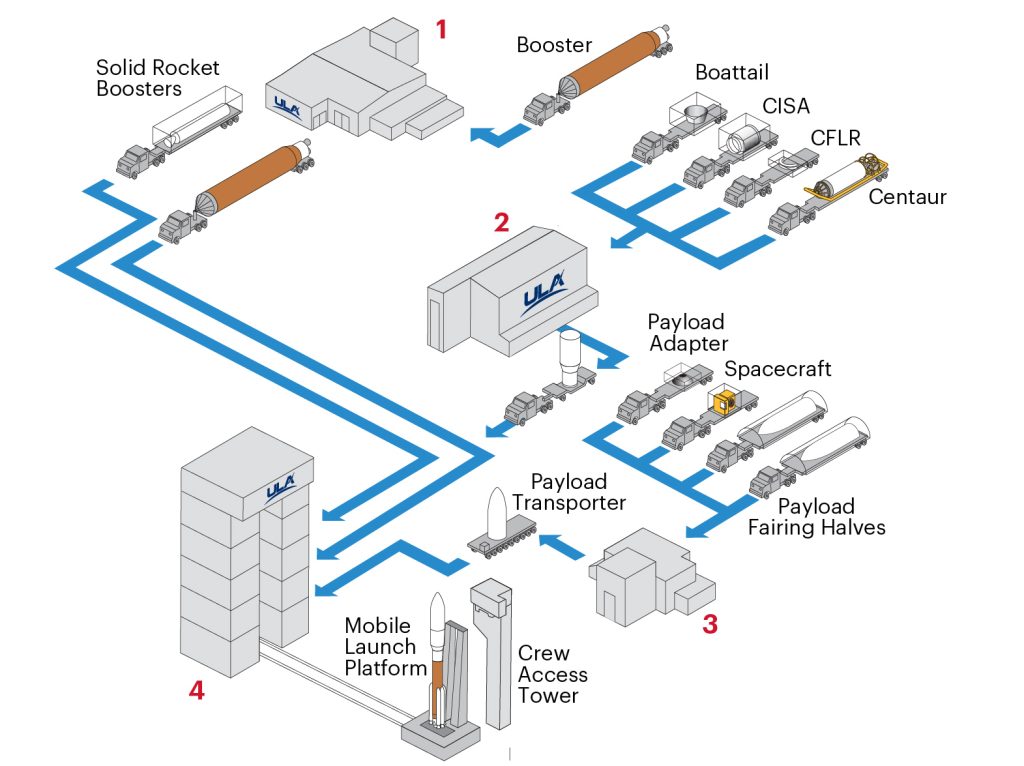
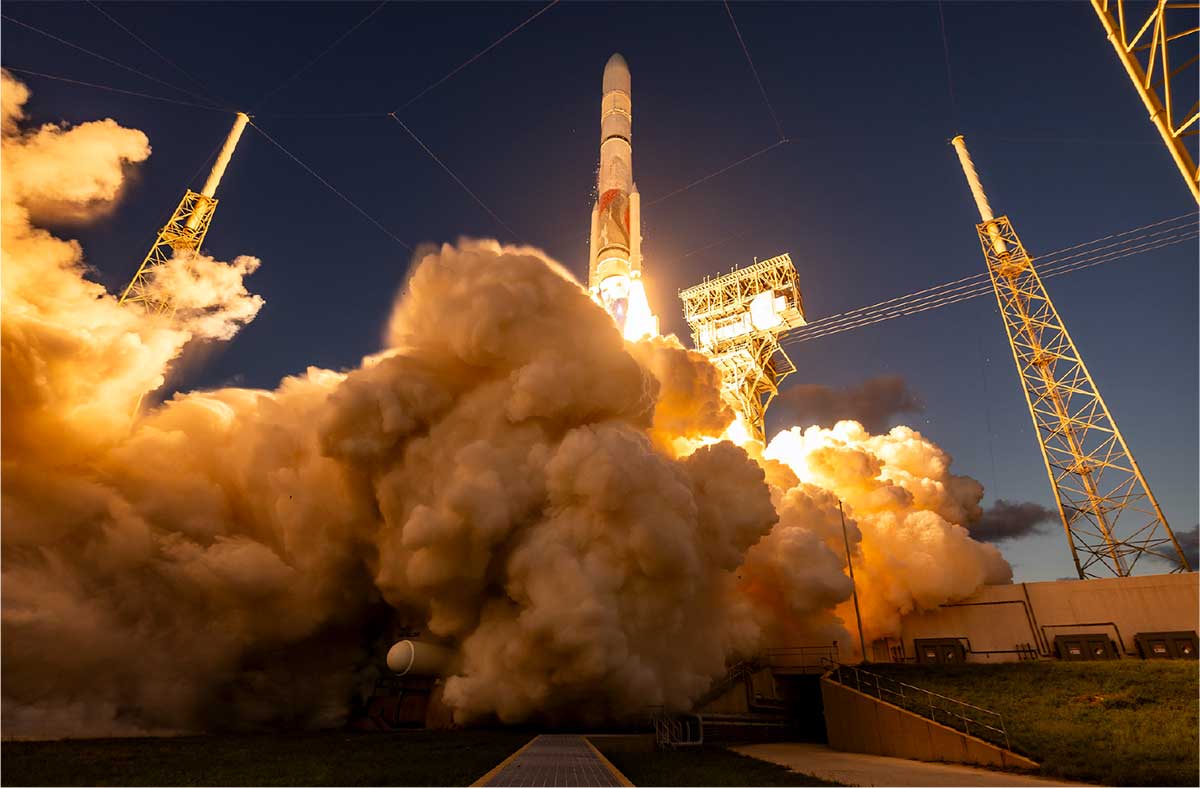
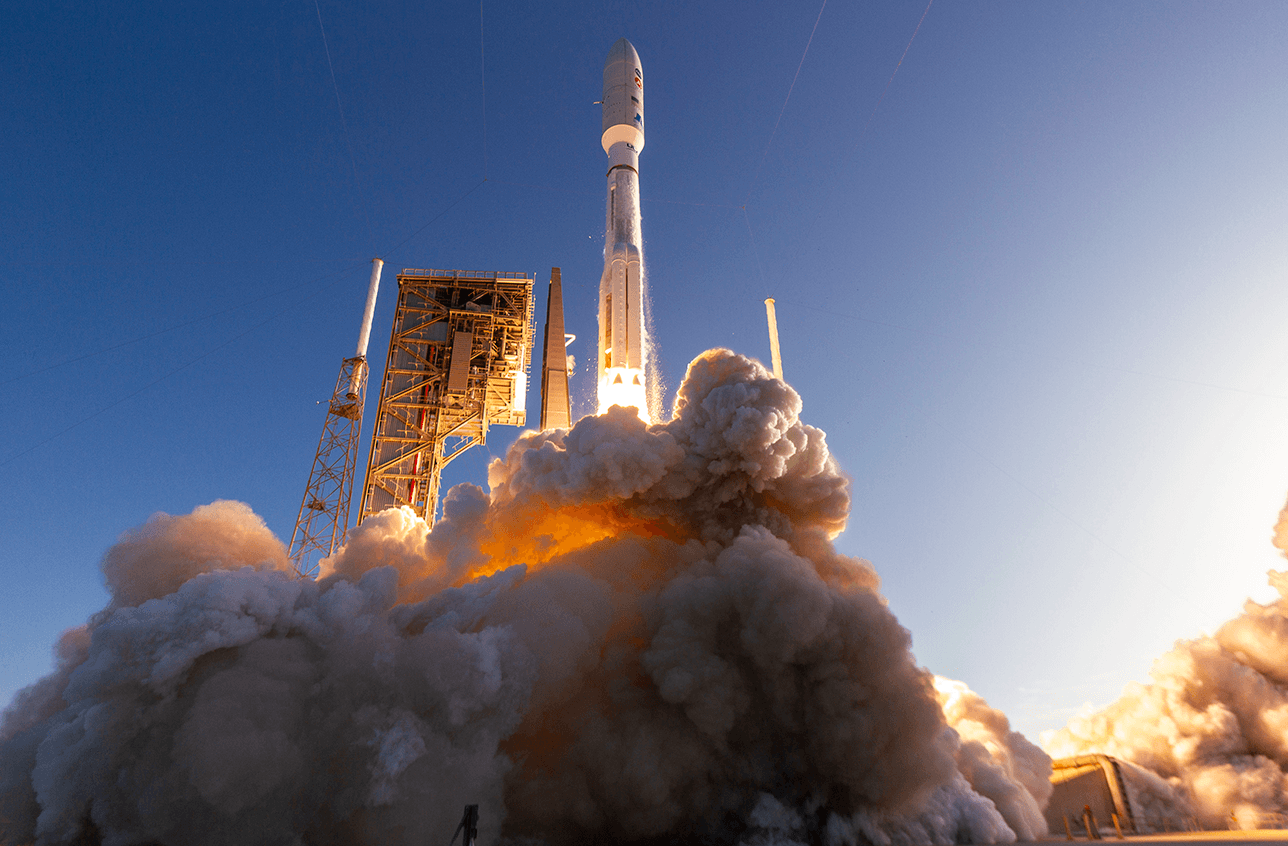
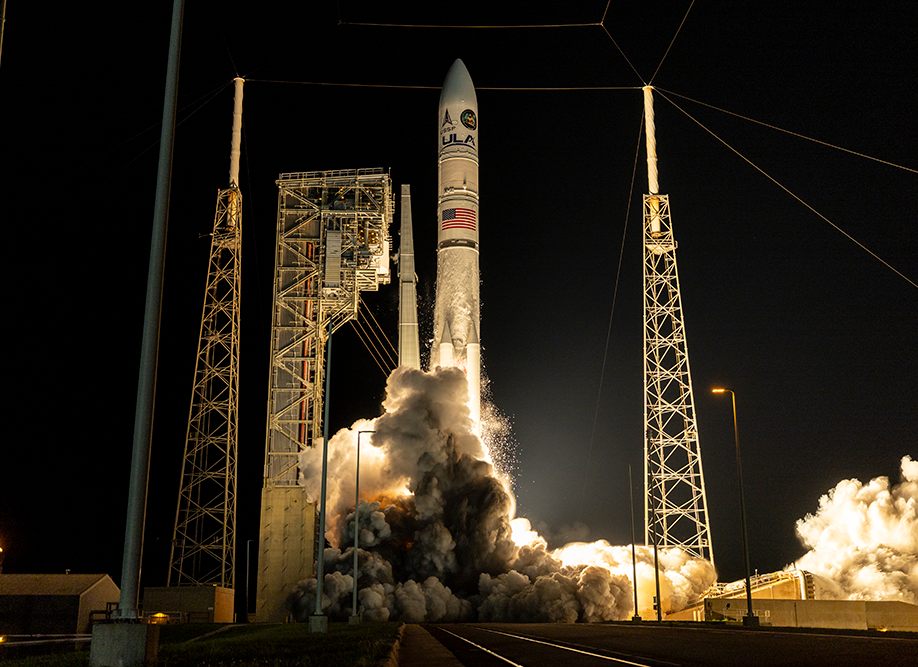
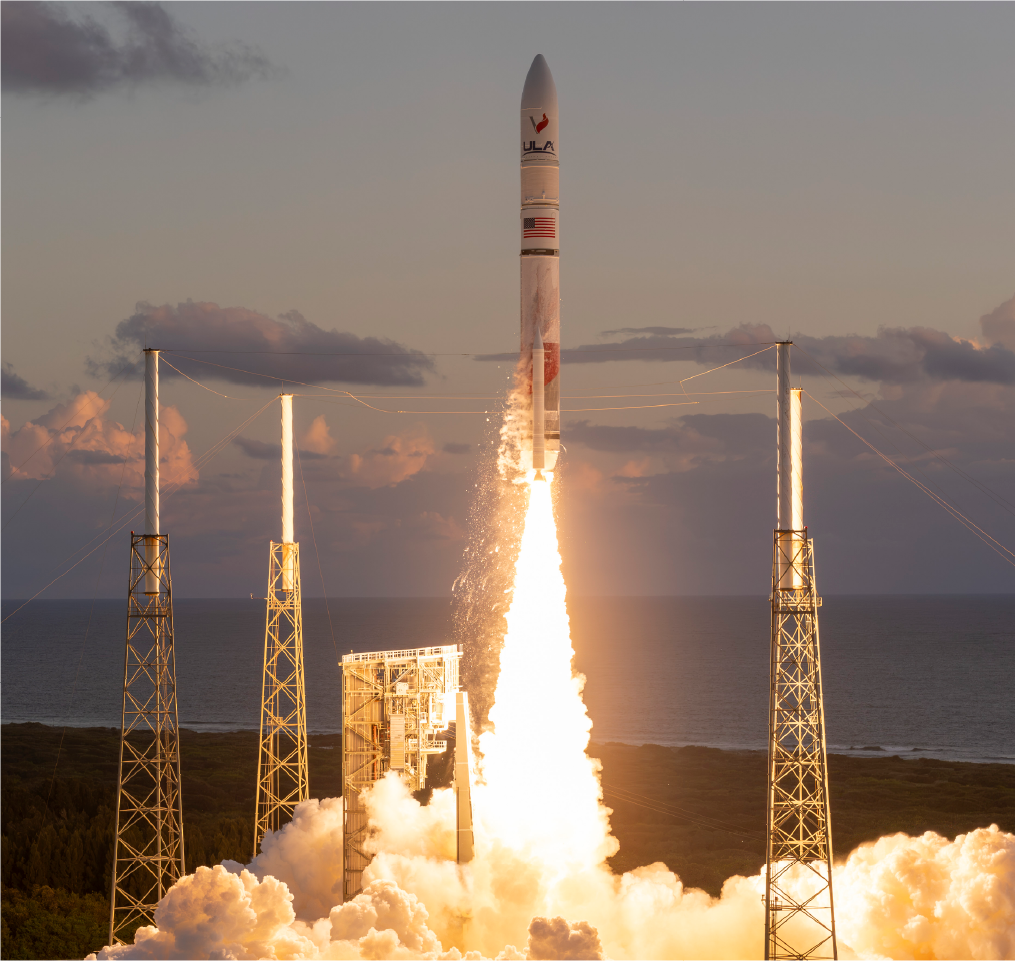
Space Launch Complex-41, the East Coast home of the Vulcan and Atlas V rockets at Cape Canaveral Space Force Station in Florida, employs a “clean pad” concept of operations to ready launch vehicles and payloads for ascent into space. The rocket elements are assembled atop a Vulcan Launch Platform (VLP) inside the Vertical Integration Facility (VIF) located adjacent to the launch pad. The platform and fully stacked Vulcan rocket then travel by rail approximately 1,800 feet northward from the VIF to the pad for the final countdown, fueling and liftoff.
1. Segment Ready Storage (SRS) Facility
2. Advanced Spaceflight Operations Center (ASOC)
3. Delta Operations Center (DOC)
4. Vertical Integration Facility (VIF)